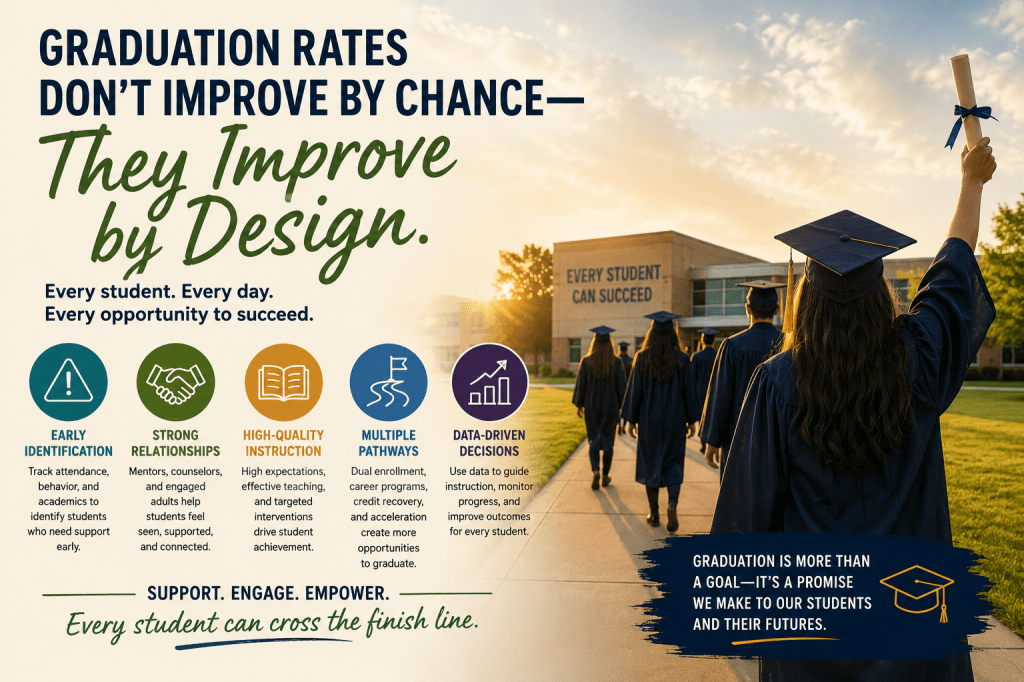
Every school district wants to increase its graduation rate. The real question is: What systems are in place to ensure students reach graduation?
Far too often, schools wait until a student is failing multiple classes or has accumulated excessive absences before intervening. By then, the path back to graduation becomes much more difficult. Successful districts understand that dropout prevention is not a single program—it is a comprehensive system built on early identification, intentional intervention, and continuous monitoring.
Our approach begins with an Early Warning System that tracks the three strongest predictors of graduation: attendance, behavior, and academic performance. When students begin to slide off track, educators respond immediately with targeted supports rather than waiting for failure to occur. This proactive mindset allows schools to address challenges before they become barriers to graduation.
Equally important is creating meaningful connections between students and adults. Every student deserves to know that someone in the building notices their successes, recognizes their struggles, and is committed to helping them succeed. Mentoring, counseling, family engagement, and extracurricular involvement all contribute to a stronger sense of belonging—one of the most powerful factors in keeping students in school.
Improving graduation rates also requires strong instruction, high expectations, and a commitment to continuous improvement. Schools must use data to guide decisions, provide targeted academic interventions, expand college and career opportunities, and create multiple pathways for students to earn a diploma. When educators work collaboratively around student needs, graduation becomes an achievable goal for every learner.
Graduation is more than a statistic. It represents opportunity, economic mobility, and hope for students and their families. Every diploma earned reflects countless intentional decisions made by educators who refused to let a student fall through the cracks.
The most effective dropout prevention plans are not simply documents placed on a shelf—they are living frameworks that shape daily decisions, strengthen school culture, and keep students connected to a future filled with possibilities.
When schools move from reacting to problems to designing systems for student success, graduation rates don’t just improve—they become the expectation.
I am the son of two dedicated educators, and growing up I vowed never to follow in their footsteps. Instead, I pursued football, earning a scholarship to Louisiana Tech University where I had the privilege of serving as captain of the football team. My college years were filled with both triumphs and challenges, but through perseverance I earned a B.S. in Mathematics with a minor in English, along with coursework in computer programming. At graduation, I was confident that opportunities awaited a young Black male with leadership experience, academic discipline, and athletic credentials. However, the career path I envisioned did not immediately materialize. Instead, I was offered a position teaching high school mathematics, stepping into the shoes of a highly respected teacher in a neighboring community. What began as a one-year commitment evolved into a calling. After that year, I returned to Louisiana Tech to pursue a Master of Education in Secondary Mathematics, which became the foundation of my career in education. My journey then took me to Arlington, Texas, where I spent six years teaching math and coaching. During that time, I learned the importance of modeling excellence both inside and outside the classroom. I poured myself into teaching with the same intensity I brought to coaching, and I was fortunate to grow alongside skilled professionals who shaped my early philosophy as an educator and leader. The relationships and experiences I built during this period remain invaluable. The next chapter of my career brought me back home to Natchez, Mississippi, where I served as Head Football Coach and math teacher at Natchez High School—my alma mater. Coaching and teaching in my hometown was a dream realized. I dedicated myself to my school and community, and together we experienced tremendous growth in both academics and athletics. The memories we created and the success of my students and athletes, many of whom are now thriving as young adults, remain my greatest rewards. In 2014, I completed my dissertation and earned a Ph.D. in Educational Administration from the University of Southern Mississippi. This milestone deepened my commitment to leadership in education. Today, I serve as the 9th Grade Principal and District Dropout Prevention Coordinator at South Panola High School in Batesville, Mississippi. Now in my fourth year in this role, I continue to learn, grow, and lead. My current platform allows me to share my experiences, advocate for students, and collaborate with colleagues on pressing educational challenges. Looking back, I see that my vow to avoid education was simply a detour to my true purpose. Each step of my journey has prepared me to influence lives, lead with integrity, and build systems that give students opportunities to thrive.
View all posts by Dr. Lance K. Reed