

Blog

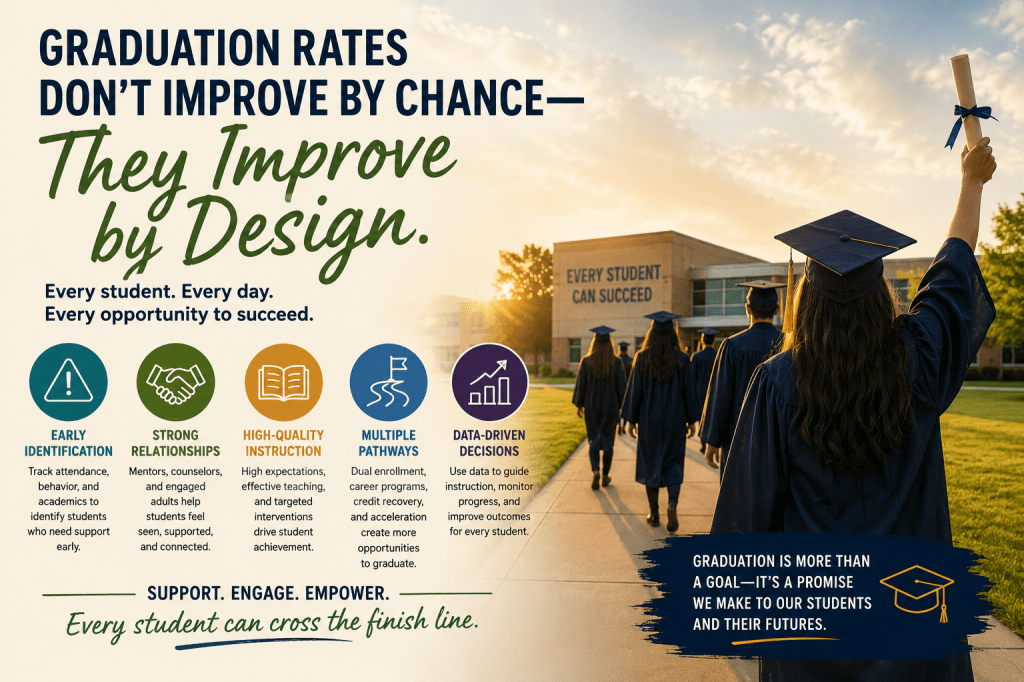
Graduation Rates Don’t Improve by Chance- They Improve by Design

Dr. Lance K. Reed

Every school district wants to increase its graduation rate. The real question is: What systems are in place to ensure students reach graduation?

Far too often, schools wait until a student is failing multiple classes or has accumulated excessive absences before intervening. By then, the path back to graduation becomes much more difficult. Successful districts understand that dropout prevention is not a single program—it is a comprehensive system built on early identification, intentional intervention, and continuous monitoring.

Our approach begins with an Early Warning System that tracks the three strongest predictors of graduation: attendance, behavior, and academic performance. When students begin to slide off track, educators respond immediately with targeted supports rather than waiting for failure to occur. This proactive mindset allows schools to address challenges before they become barriers to graduation.

Equally important is creating meaningful connections between students and adults. Every student deserves to know that someone in the building notices their successes, recognizes their struggles, and is committed to helping them succeed. Mentoring, counseling, family engagement, and extracurricular involvement all contribute to a stronger sense of belonging—one of the most powerful factors in keeping students in school.

Improving graduation rates also requires strong instruction, high expectations, and a commitment to continuous improvement. Schools must use data to guide decisions, provide targeted academic interventions, expand college and career opportunities, and create multiple pathways for students to earn a diploma. When educators work collaboratively around student needs, graduation becomes an achievable goal for every learner.

Graduation is more than a statistic. It represents opportunity, economic mobility, and hope for students and their families. Every diploma earned reflects countless intentional decisions made by educators who refused to let a student fall through the cracks.

The most effective dropout prevention plans are not simply documents placed on a shelf—they are living frameworks that shape daily decisions, strengthen school culture, and keep students connected to a future filled with possibilities.

When schools move from reacting to problems to designing systems for student success, graduation rates don’t just improve—they become the expectation.

Participation Matters: How Student Involvement Drives Graduation Success in Today’s Schools

As schools across the country grapple with declining engagement, chronic absenteeism, and post-pandemic learning loss, one question continues to surface: What actually keeps students connected to school long enough to graduate?

A growing body of research — including my own — points to a clear and consistent answer: student participation matters.

What the Research Has Long Shown

In my doctoral research examining public high schools in Mississippi, I investigated the relationship between participation in extracurricular activities and key student outcomes, including GPA, ACT scores, and attendance  . After controlling for gender, race, and socioeconomic status, the findings were clear:

Students who participated in extracurricular activities demonstrated higher GPAs Participants posted higher ACT scores Students involved in activities had fewer absences Teachers and administrators overwhelmingly perceived positive impacts on behavior, academics, and attendance

These outcomes are not accidental. Participation creates structure, accountability, and meaningful relationships — three elements that research consistently links to school completion and graduation.

The Graduation Connection

Graduation is not a single academic event; it is the culmination of consistent attendance, academic persistence, and student engagement. Participation strengthens all three.

Students who are involved in athletics, band, clubs, or academic organizations are:

More likely to attend school regularly More connected to peers and adults Less likely to disengage or drop out More invested in meeting eligibility and academic requirements

In short, participation creates a reason to stay.

How Current Trends Reinforce These Findings

Today’s education landscape makes these findings even more urgent.

1. Chronic Absenteeism Is a National Crisis

Post-COVID data shows chronic absenteeism remains significantly higher than pre-pandemic levels. Schools with robust extracurricular offerings report better daily attendance because students feel needed and missed when they are absent.

2. Whole-Child Education Is No Longer Optional

Modern school accountability frameworks increasingly emphasize social-emotional learning, belonging, and school climate. Extracurricular activities naturally support these priorities by fostering teamwork, leadership, and self-discipline.

3. Graduation Rates Are Tied to Engagement, Not Just Academics

Current research trends show that academic interventions alone are insufficient. Students who feel disconnected from school — even if academically capable — are more likely to disengage. Participation acts as a protective factor that keeps students anchored.

4. Equity Conversations Highlight Access to Opportunity

One of the most pressing trends in education is ensuring that all students — particularly those from low-income backgrounds — have access to extracurricular opportunities. My research highlighted participation as especially impactful when socioeconomic barriers are removed or reduced  .

Why Cutting Activities Is a Risky Strategy

During budget discussions, extracurricular programs are often viewed as expendable. However, the data suggests the opposite. When schools reduce participation opportunities, they often see:

Increased absenteeism Declines in school climate Weaker student-adult relationships Lower graduation persistence

Extracurricular programs are not add-ons; they are engagement engines.

Moving Forward: Participation as a Graduation Strategy

If schools are serious about improving graduation rates, participation must be part of the strategy. This means:

Expanding access to activities, not limiting them Viewing extracurricular participation as an intervention, not a reward Using participation data alongside academic and attendance metrics Intentionally connecting disengaged students to programs

Final Thought

Graduation does not happen in isolation. It happens when students feel connected, supported, and motivated to show up — day after day.

More than a decade ago, my research demonstrated that extracurricular participation positively influenced attendance, achievement, and behavior. Today’s trends only reinforce that conclusion: when students participate, they persist — and when they persist, they graduate  .

Chronic Absenteeism: Causes, Data, and Solutions

By Dr. Lance K. Reed

Meta Description (SEO):

Explore the causes of chronic absenteeism and how student engagement—especially through extracurricular activities—can improve attendance. Practical, research-based strategies to help schools take action.

Introduction

Chronic absenteeism has emerged as one of the most pressing issues facing schools today. Recent data from the U.S. Department of Education shows that more than 1 in 4 students missed 10% or more of the school year in 2021–2022. These numbers reflect a troubling post-pandemic trend, with attendance rates yet to recover in many districts.

As an experienced school administrator and researcher, I’ve spent years studying the patterns behind attendance. My dissertation, “Relationships Between Participation in Extracurricular Activities, ACT Scores, GPA, and Attendance in Select Public High Schools in Mississippi,” revealed a consistent pattern: students who engage in school beyond the classroom show up more—and do better.

Let’s take a closer look at what’s driving chronic absenteeism and how schools can respond.

What Is Chronic Absenteeism?

Chronic absenteeism is typically defined as missing 10% or more of instructional days, regardless of whether the absences are excused or unexcused. That translates to about 18 missed days in a 180-day school year.

This measure goes beyond truancy. It shines a light on patterns of disengagement that often go unnoticed until it’s too late.

Top Causes of Chronic Absenteeism

Chronic absenteeism is rarely about laziness or defiance. More often, it reflects:

Disengagement: Students who don’t feel a connection to school are more likely to stay home. Health & Mental Health: Anxiety, depression, and untreated conditions are growing factors, especially after COVID-19. Family & Economic Challenges: Housing instability, job obligations, or lack of transportation impact daily attendance. Discipline & Suspensions: Exclusionary practices often escalate absenteeism among at-risk students. Low Academic Confidence: Students falling behind academically may begin to avoid school altogether.

What the Research Shows

In my study of Mississippi public high schools, students actively involved in extracurricular activities:

Had fewer absences than those not involved Demonstrated higher GPAs Showed lower rates of behavior referrals

The data reinforced what many educators already sense: student engagement is directly tied to attendance, achievement, and behavior. When students participate in something meaningful, school becomes a place they want to be.

Strategies to Reduce Chronic Absenteeism

Here are research-backed steps schools can take to combat absenteeism:

1. Expand Opportunities for Engagement

Open access to clubs, athletics, and leadership groups for all students—not just high-achievers. Focus on inclusion, not exclusion.

2. Build Positive Relationships

Mentorship programs, advisory periods, and consistent adult check-ins help students feel seen, supported, and accountable.

3. Improve Communication with Families

Reach out proactively when attendance declines. Share why attendance matters—not just the rules, but the impact.

4. Track and Act on Early Warning Signs

Use weekly or monthly attendance tracking to flag trends. Don’t wait until a student has missed 20 days—intervene early.

5. Recognize and Celebrate Progress

Celebrate improved attendance, not just perfection. Recognize effort. Create a school culture where “showing up” is a shared goal.

Conclusion

Solving chronic absenteeism won’t happen through policy alone—it requires relationships, data, and student-centered engagement. My research confirms that participation in school life beyond the classroom drives stronger outcomes in attendance, behavior, and academics.

We must make schools places of purpose, belonging, and opportunity.

Because when students show up—everything changes.

How Athletics Build Smarter, Stronger Students: From Practice to Progress

By Dr. Lance K. Reed

When people talk about student success, they often focus on grades, test scores, or curriculum. But from my years in education—and through my dissertation research—I know another major factor often gets overlooked: athletics.

This post isn’t about Friday night lights or championship trophies. It’s about how consistent participation in sports—whether it’s football, cheer, track, or cross-country—transforms how students show up academically. Not just in motivation, but in measurable cognitive growth, emotional control, and life habits that matter far beyond the game.

Movement as a Learning Accelerator

What happens on the practice field doesn’t stay there. Daily physical exertion enhances oxygen flow to the brain, builds neural connections, and improves executive functioning—especially for students who struggle in traditional settings. Athletes are practicing sustained focus and rapid decision-making every day, which carries directly into math, reading, and science performance.

That’s not just theory. My dissertation findings confirmed it: students involved in athletics showed greater academic consistency and fewer discipline referrals compared to non-participants.

The Discipline of Time

One of the most underrated academic strengths student-athletes build is time management. Balancing school, practice, and games forces students to prioritize, plan, and follow through. Many of the students I worked with said being in sports made them better students—because they couldn’t afford to procrastinate.

This daily discipline isn’t just helpful—it’s transformative.

Emotional Control: A Hidden Classroom Skill

Academic success isn’t just about intelligence—it’s about regulation. Sports teach students how to process failure, stay composed under pressure, and bounce back from setbacks.

Whether it’s a missed shot in a game or a low score on a quiz, students with athletic experience are often more resilient, more adaptable, and less likely to disengage. That’s a skill set every classroom benefits from.

Leadership in Action

Athletics also build leaders. On the field or court, students learn to take responsibility, support teammates, and make decisions quickly. In school, these same students are more likely to take initiative in group projects, speak up in class, and serve as peer mentors.

These aren’t just “soft skills”—they’re life skills.

What Schools Can Do Now

Here are a few simple steps school leaders can take to build on the benefits of athletics for academic success:

Schedule smarter: Use practice calendars as examples to teach time management to all students. Make the connection: Help students understand the brain-body link by teaching the science behind movement and focus. Promote inclusion: Encourage participation across all ability levels—not just elite athletes. Extend support: Use tutoring, recovery zones, and mentoring programs modeled after athletics to support all students.

Final Thought: Sports as Academic Fuel

Athletics aren’t just an after-school activity—they’re a foundation for success. They create structure, build confidence, and develop the kinds of cognitive and emotional habits students need to thrive in every part of life.

It’s time we stop calling athletics “extracurricular.”

They’re essential.

Dr. Lance K. Reed

Researcher/Student Engagement Advocate

Why Participation Matters: The Academic Power of Extracurriculars

In today’s educational landscape, school leaders are searching for effective strategies to boost student achievement, improve attendance, and reduce dropout rates. While technology integration and curriculum design often dominate the conversation, one of the most overlooked—but highly impactful—factors is student participation in extracurricular activities.

Research-Backed Benefits

In my doctoral research, “Relationships Between Participation in Extracurricular Activities, ACT Scores, GPA, and Attendance in Select Public High Schools in Mississippi” (University of Southern Mississippi, 2014), I found a statistically significant relationship between student participation and key academic indicators:

– Students involved in extracurricular activities had higher GPAs than their non-participating peers.
– Participants scored better on the ACT, even when controlling for other variables.
– Attendance was consistently higher among students involved in athletics, clubs, or performing arts.
– Behavior referrals were generally lower in engaged students.

These findings echo what we are seeing nationwide. In 2024, the National Center for Education Statistics (NCES) reported that students involved in at least one extracurricular activity were more likely to attend school consistently and graduate on time. With post-pandemic absenteeism still plaguing many schools, this data is more important than ever.

The Current Problem

As of mid-2025, many districts are still reporting chronic absenteeism rates above 20%, according to data from Attendance Works. In some high schools, disengagement is driving down both academic performance and student morale. Meanwhile, extracurricular programs are being cut due to budget constraints—even though these programs are often the very thing keeping students connected to school.

The Opportunity for Change

This is where school leaders must lean in.

Participation isn’t just an “extra.” It’s essential.

When students join a team, club, or organization, they build responsibility, social bonds, and intrinsic motivation to succeed—not just on the field or stage, but in the classroom.

The upcoming REED Platform is being designed to help districts monitor this impact in real-time, showing how participation correlates with GPA, attendance, ACT performance, and behavior. With this data, administrators can evaluate programs, guide sponsors, and advocate for the resources that keep students engaged.

Key Takeaway

If you’re an administrator, counselor, or teacher—ask yourself:

Are your students participating?
And if not, what’s keeping them on the sidelines?

The data is clear: Participation matters.
It’s time we treat extracurricular engagement as a core part of our school improvement strategies—not an afterthought.

Next Week: From Practice to Progress: How Athletics Boost Classroom Success